
Affirmation, Not Invention: The Evidence of Your Executor Status.
The State relies on your ignorance of history to maintain its illusion of Absolute Sovereignty. Review the ancient charters, maxims, and oaths that legally guarantee your standing.
The Golden Thread of History Tracing the "Chain of Title" through the ages.
The Great Charter
The moment the King (The State) admitted he was under the Law, not above it . It established that the Crown has duties, not just rights.
The Receipt:
"To no one will we sell, to no one will we deny or delay, right or justice." — Clause 40
Confirmation of Liberties
King Edward I confirms Magna Carta into Statute Law. This ensures the Trust remains in force today. It is not merely history; it is the active "Source Code" of our legal system.
The Receipt:
"No free man shall be taken or imprisoned... but by lawful judgment of his peers or by the law of the land." — Article 29.
The Settlement
The binding legal agreement where the State swore to serve the People’s Law. This is the foundational "Job Description" for every public official.
This is not just a contract; it is your constitutional kill-switch. The Bill of Rights 1688 explicitly states that no statutes shall cause 'prejudice' to the subjects. Crucially, the State does not get to decide what harms you. Only the individual has the authority to assess material or spiritual prejudice. If a statute causes you prejudice, the agent enforcing it acts Ultra Vires (beyond their power).
The Receipt:
"I solemnly promise and swear to govern the People... according to the statutes in Parliament agreed on. and the laws and customs of the same?" — Coronation Oath Act.
The Great Forgetfulness
The rise of "Legal Positivism." The State began to act as if it were the source of Law, rather than its servant. The "Chain of Title" was hidden, but not broken.
The emergence of the "Administrative State" and the "Trustee de son tort."
The Affirmation
The Genesis Trust. The Genesis Trust is reaffirming the Original Trust Deed. By noticing the State of their Personal Liability, we restore the correct order of governance: The State answers to the People, and the People answer to the Law.
YOU ARE HERE.
The Coronation Oath (1688)
This is the binding verbal contract every Monarch must swear to become the Trustee. It proves they are servants under the Law, not Masters above it.
Part I: The Civil Contract
The Archbishop asks:
"Will you solemnly promise and swear to govern the People... according to the statutes in Parliament agreed on, and the LAWS AND CUSTOMS of the same?"
"I solemnly promise so to do."
Part II: The Link to the Grantor
The Archbishop asks:
"Will you to the utmost of your power maintain the LAWS OF GOD and the true profession of the Gospel?"
"All this I promise to do."
The Monarch then lays their hand on the Holy Gospel to bind their conscience.
Note: By swearing to maintain the "Laws of God," the State admits there is a Higher Law (Natural Law) that it cannot overrule.
The Source Code of Law
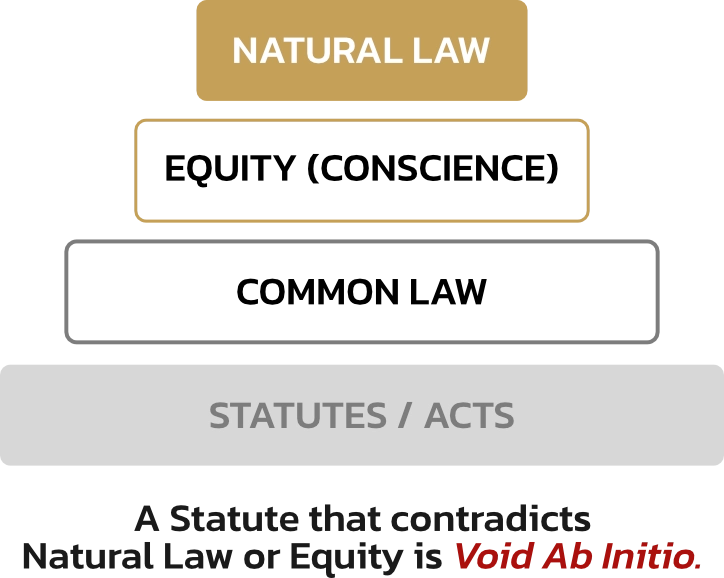
Every system has a foundation. In the People's Constitution, the 'Source Code' is the original authority granted by the Grantor (God). This creates a strict hierarchy: a lower administrative rule can never overwrite the original title. When a statute conflicts with Natural Law or your Conscience, it is not just 'bad'—it is legally invalid from the moment it was written (Void Ab Initio).
"No One Can Give What They Do Not Have" Nemo Dat Quod Non Habet
The State cannot claim sovereignty because the People (who created the State) never had sovereignty to give.
"An Unjust Law is Not Law" Lex Injusta Non Est Lex
Any statute that violates the Grantor's Law or the Beneficiary's Conscience is void from the start (Void Ab Initio).
The Hierarchy of Law
"Rule of Law" does not mean "Rule by Statute." There is a strict hierarchy. A lower law can never overturn a higher law.

Natural Law (Divine Law):
The absolute moral standard established by the Grantor (God). It is unchangeable and grants Dominion to Mankind
Equity (Conscience):
The "Fairness" that protects the Trust. It resides in the Beneficiary. Equity compels the Trustee to perform its duties and overrides rigid, unfair Statutes.
Common Law (Reason):
The accumulated wisdom, customs, and historic protections (like Magna Carta) of the People.
Statute Law (Legislation):
Corporate administrative rules for the internal management of the State. This is the lowest form of law. A Statute that contradicts Natural Law or Equity is Void Ab Initio.




The Evidence is Undeniable. Now Take Action
You have seen the historical receipts. The State is merely a conditional servant, and you hold the constitutional kill-switch. Do not fight them in their courts. Learn the Strategy of Peace and put on your legal "Spacesuit.